We had an extended trip to London for Gareth’s birthday, which included a theatre trip to the Royal Court, a fancy afternoon tea at the Ivy, a classical concert at the Barbican, and a visit to the Courtauld Gallery which was free for us both with our National Art Pass.
Because we love watching Fake or Fortune, we were kind of hoping to bump into Professor Aviva Burnstock there, who is a Conservator at the Courtauld Institute (which is actually up near King’s Cross, so nowhere close to the Gallery.) So obviously, we didn’t get to see her, but we did see some art, some of which I liked, some of which I was quite indifferent to, but that’s usually my experience of seeing visual art everywhere, so nothing new on that front.
I’m just not really that much of a visual art person. And at the age of 46, I’m comfortable with that. But the building itself has an inscribed warning on the wall, seemingly designed to suggest that people like me are not entirely wanted or welcome…
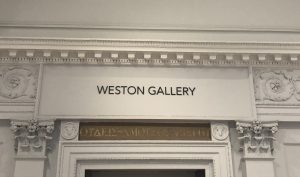
My photo isn’t the clearest — but what it says, in Greek, beneath the entrance to the Weston Gallery, is: ΟΥΔΕΙΣ ΑΜΟΥΣΟΣ ΕΙΣΙΤΩ (pronounced “Oudeis amousos eisito”). An information panel on a nearby wall has this to say:
Visitors to the Royal Academy’s annual Summer Exhibition came through this ante-room (lobby). The Greek text above the door translates roughly as “Let no Stranger to the Muses Enter.” In other words, entry was reserved for visitors who appreciated art. The Academy’s ideal visitor was an intellectually curious man of taste. The exhibitions, however, drew large crowds and, while not inclusive by today’s standards, provided access to art to a varied audience.
Uh-oh… Should I have got my coat and bag from the locker and just left quietly…?
“It is hard to imagine a sentiment more at odds with 21st-century museum mantras of inclusiveness and anti-elitism,” said a Financial Times article on the Courtauld, back in 2018. Quite. (Although coming from a newspaper in The Times Group, that sounds perilously like the pot calling the kettle black.) I can imagine some institutions would have covered that inscription up by now and pretended that it wasn’t there. I can also imagine some people pushing back if that happened, loudly defending the statement, precisely so that people like me shouldn’t have the opportunity to set foot inside the gallery in the first place.
Museums, indeed all cultural buildings, agonise over fears that they exclude, or are perceived to exclude, people from entering and enjoying them. The Greek frieze shows precisely where these exclusions, and perceptions of exclusion, have their troublesome roots.
I have to point out that I didn’t feel the least bit unwelcome at the Courtauld, and might well pop back again sometime for another look at the works I liked. And the basement shop is great, including glorious little crocheted Vincent van Gogh keyrings (but surely a squandered opportunity to have represented him with a little woollen bandage over his missing ear?)
But if I was the gallery management, I think I’d have another crack at rewriting that context panel, to make it sound a bit more inviting. It made me feel ever so slightly icky, and that’s speaking from my standpoint as an “intellectually curious man of taste” — insofar as my taste is defined purely on my own terms, and doesn’t needed to be dictated for me by anybody else, least of all a set of long-deceased Royal Academicians.
PS — if you want to spare yourself the awful indignity of being a continued Stranger to the Muses, perhaps you might like to listen to this episode of In Our Time with Melvyn Bragg and his guests, discussing the Muses and their wider cultural context. (I haven’t listened to it myself yet, so make of that — and me — what judgement you will.)