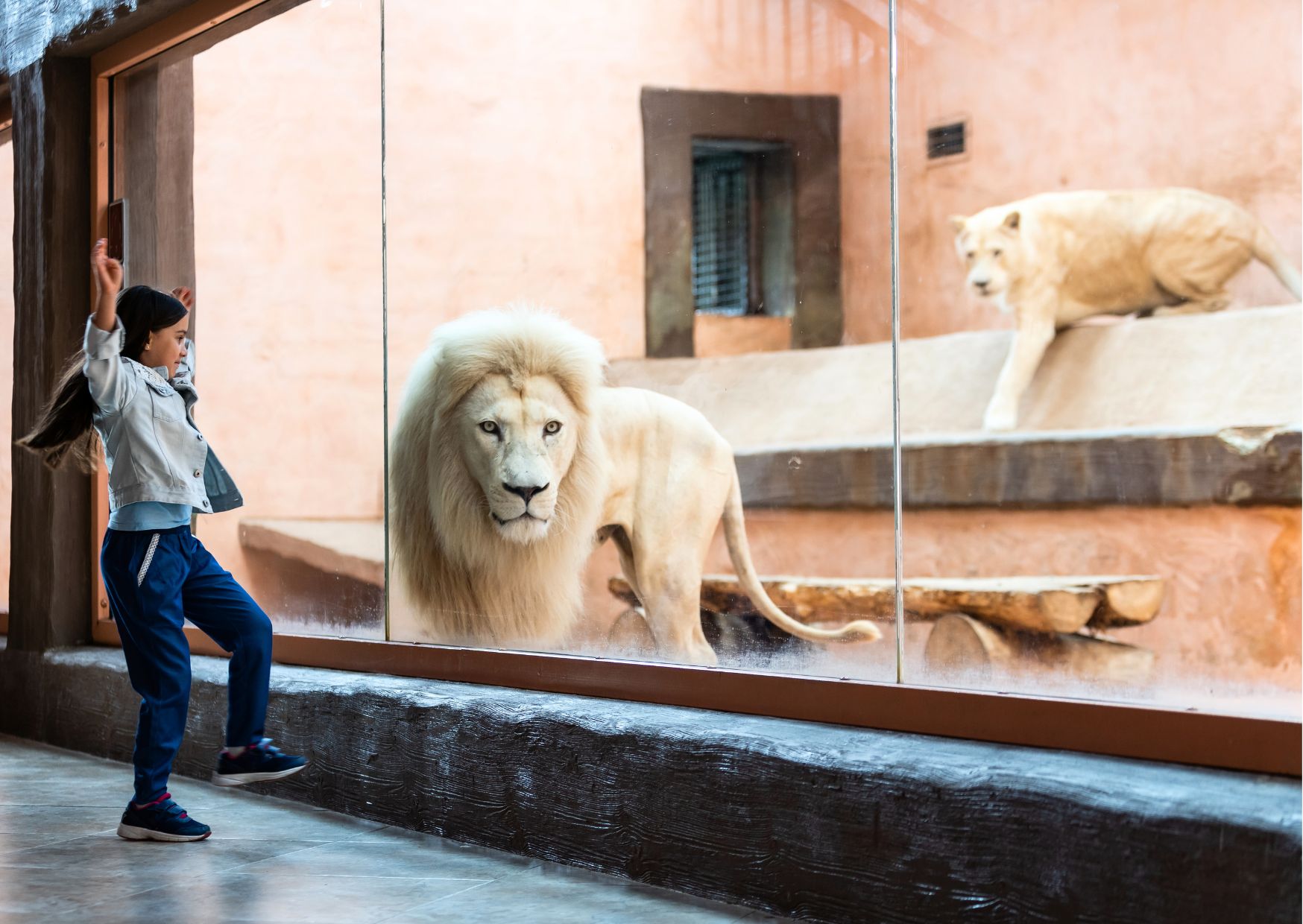
I turned 47 recently, and we continued a tradition that’s been upheld across the last few years by going to see some animals on my actual birthday (after a big slap-up breakfast first). In recent years, we’ve done visits to zoos, safari parks, and even a crocodilarium (near Oxford, in case you were wondering where such a place exists); this year, we went to a zoo I’ve had a relationship with since I was at primary school.
I don’t need anyone to point out the many areas of concerns that people have about such places, don’t need anyone talking to me about ethics or about animal cruelty or about the minimal impact many collections have on conservation. I still think there is a role for these places to play, provided that the welfare of the animals is prioritised. You may not feel the same; let’s agree to disagree.
This year, my birthday fell on the Saturday of a Bank Holiday weekend, in a spell of hot weather, so the zoo we visited was BUSY. And over the course of several hours, during which I observed the humans around me as much as the animals in front of me, I learned a few things about audiences. Or rather, several things I already knew or suspected were confirmed for me by some of the behaviour on show. I’m no ethologist, but I don’t need to be — a lot of what I saw and heard requires no complex interpretation.
Here are some of the habits I noticed amongst the zoo visitors — it’s interesting to speculate on how they might apply to, or manifest themselves in, the audiences of many art forms as well. Everything in quotation marks below is something I heard firsthand on this trip, or a past trip.
1) People are inclined to express very simplistic viewpoints about the thing they are looking at, and to express those viewpoints in very simplistic language.
This is not, I will emphasise, limited to the way adults communicate with children about animals, although this is where it is most nakedly apparent. Adults behave and speak this way between themselves very readily, as if a behaviour forms in childhood that persists into later life.
“Isn’t he tall?“, said countless people about a giraffe. “Look how stripy he is!“, said countless people about a zebra. The elephants are gone from this particular collection now, but on previous visits, I heard variations on “He’s very big, isn’t he?” from all sides. The presence of a living, breathing, feeling creature is immaterial here. We might as well be sat at home reading Rod Campbell’s Dear Zoo — a book I rate highly, but not one I’d point anyone towards to expand their understanding of or empathy towards the animal kingdom.
2) People interpret the sex of the animals they see in ways which are very revealing about their own social conventions around power, status, body shape, gender, and group organisation.
As with the giraffe, zebra, and elephants mentioned above, almost everyone defaults to defining the animal in front of them as “he”, rarely “she”, and almost never “it”.
Following on from this, if more than one animal is visible at any one time, the larger animal/s will tend to be assumed male, and the smaller one/s will tend to be assumed female.
The exception is when an animal is seen holding an infant, at which point almost everyone will default to assuming it is female — more specifically, “Mummy”.
Case in point: we saw a trio of gibbons, made up of a smaller animal and a larger animal and a little baby, which the smaller one kept trying to touch, to hold, or to release from the larger one’s grip. Without question, the larger one was an adult female and the baby was hers. Everyone I heard talking about these animals assumed the smaller one was “Daddy”.
It was, in fact, a juvenile, the adult female’s grown-up offspring — perhaps a male or female teenager trying to play with the baby, or maybe trying to tease it, or maybe trying to get it out of the way in order to reclaim some of the mother’s attention (or milk). Perhaps it was an adolescent female, consciously or unconsciously trying to learn parenting skills by taking charge of the baby (against the mother’s wishes at that time).
Nobody around us, as far as I could tell, ever saw fit to look beyond the most obvious surface dynamics of what was in front of them. Three animals together automatically constituted a standard family unit. There was no need, and no curiosity, to question things any further.
3) People like to impose their own pre-formed opinion on what they are seeing, assuming that the knowledge they arrive with is already complete, or else adequate enough.
This follows on from Note 2 in some ways. Every primate that people spoke about was a “monkey”, regardless of whether it was in fact an ape, a monkey, a lemur, or anything else.
They showed little willingness to have that opinion challenged or reframed, even when there were plenty of (admittedly, quite basic) interpretation panels on hand. Most people never even glanced at them. They had little or no interest in taking on new information about the animals they encountered. They already knew best. Learning anything new was pointless, irrelevant, and if anything, would have spoiled their enjoyment of the day.
4) People prefer instead to treat the animals they see as pieces of pure spectacle, and they move on as soon as they get bored — and people get bored very easily.
Large mammals held people’s attention longest, but not for long; then smaller animals which were quite active (such as meerkats or penguins); then anything which was small and/or inactive and/or unfamiliar. Small, inactive, and unfamiliar animals were met with disinterest, even disdain.
People have little patience when it comes to observing these animals as they are. They have even less patience when it comes to waiting to see animals which are secretive and/or camouflaged.
The zoo has an Amur leopard, an incredibly rare subspecies with less than 100 individuals left in the wild. The prospect of seeing one gave me tingles. We waited a long time, on three circuits round the zoo, but never saw it once. Most people spent less than 30 seconds gawping through the glass. No instant sight of leopard, no interest, no point in staying.
5) Only two things seem guaranteed to keep audiences watching for more than a minute.
They lost their minds over the appearance of a baby, or anything assumed to be a baby (as people are not much good at distinguishing a very young individual from an individual which just happens to be small).
The other surefire audience pleaser was when an animal urinated or defecated, as hilarity collided with the shock of impropriety. Children adore the outrage of a long stream of piss or a rain of pellets emerging from an animal which registers no embarrassment at all about what it is doing.
Once upon a time, animals copulating also had zoo audiences glued, but I haven’t seen this behaviour (from animals) on any visit to any collection in years. I’d be fascinated, in this new era of extreme prudishness and extreme permissiveness, to watch visitors react to animals having sex, especially to find out how adults with children navigate what is happening.
The zoo we went to has a group of bonobos, our closest living genetic relatives, slender forest cousins of the chimpanzee which have a complex social structure regulated in part by bouts of non-procreative sex, with all sorts of combinations of participants. (Old individuals are never excluded; male-male and female-female couplings are common; the only observed taboos are sex among close relatives, and with very young individuals.)
That group must present all kinds of challenging behaviour for parents and guardians to grapple with. I’d have given anything to watch that unfold.
6) People cannot go many minutes, or even many seconds, without needing some little dopamine hit of self-validation.
This expresses itself in many ways. The obvious one is the determination many people have to put themselves into the photographs they take with animals, as though a picture of an animal has no intrinsic worth or interest on its own. I doubt that 99.9% of such photographs will ever be looked at again, until the moment someone decides to delete them to claw back some storage space on the device in question.
Another big one is people’s need to assert their own identity, experience, or existence by saying or doing something which imposes themselves on the animals in front of them. Often this comes in the form of pointlessly saying what an animal looks like.
This could be a person in their life — “He looks just like George!” or “Who’s he remind you of?” / “You!” (child to father) or “Your mom!” (father to child). It could also be a figure within their cultural consciousness — “He looks like Voldemort,” a boy strenuously insisted (about the teenage gibbon.)
Either way, the statement needs to be repeated often enough to make sure the intended audience hears it, and for them to show that they appreciate the joke, or else respond with some other gesture of approval. If the statement fails to land, the speaker will persist in repeating it until it succeeds. Children, it seems, have infinite stamina when it comes to this.
7) If something hasn’t been photographed or videoed, it may as well never have happened; if something was not recorded on a device, there was no point in it happening in the first place.
Time and again, the appearance of an animal was met with a flurry of phones and cameras being pointed at it, to capture the moment for posterity. As I said above, I doubt most of these images and films will ever be looked at again, but still, the immortalisation of experience is routinely prioritised over the experiencing of that experience.
This urge is manifesting itself at a young age now; I saw many children who must have been aged 8 or under, strolling around with iPads, looking for animals within their enclosures, immediately taking pictures of them, then wandering off a moment later. They spent mere seconds, if any time at all, simply looking at the animals directly. It was as if the animals had no point in being there except to be logged on a digital device, as if they were elements of a game.
This also links back to Note 4; there was a strong and palpable sense of disappointment, even annoyance, from people when animals failed to oblige for their cameras — by moving too fast or not moving at all, by hiding their baby, by turning their back, by being asleep. Children, in particular, seem unable to tolerate an animal not doing what they want it to, when they want it to.
8) Social media has a lot to answer for.
Overheard at the capybara enclosure: “social media has made them cool now“.
The majority of people seemed to know they were looking at capybaras, which surprised me, but their engagement with these animals went no deeper than that. “Look at him, having a swim!” “He’s eating his hay, look!” “He’s coming to say hello to you, Madison!”
Not everyone understood (or cared) what they were looking at, though — “it’s a giant guinea pig,” one woman observed. She moved on within seconds. She knew all she needed to know. She had seen all she needed to see.
9) The animals are often a small or insignificant part of the visitor experience; secondary spend is actually of primary importance.
Vast areas of the zoo which once housed animals were now empty and derelict; many enclosures and exhibits had disappeared entirely, and something quite different had appeared in their place.
A gigantic pool with rocky mountain backdrop which used to be the home for sea lions had now been replaced, with no small irony, by an immense outdoor wet play area. It was the most solidly busy part of the entire complex, all day, from morning through to late afternoon. Shrieks of children running in and out of fountains echoed around where, not so long ago, the throaty bark of a bull sea lion used to draw people from across the site to see what was going on.
Everywhere you turned now, it was easier to find an ice cream stand, a cafe, a picnic area or a playground than it was to find your way to the animals you wanted to see. (That’s assuming you were that bothered about seeing animals in the first place.) You had much more chance of being funnelled towards a throw-a-ball game to win a giant plush capybara toy than you did of stumbling across the actual capybara enclosure.
10) Put anything with The Gruffalo on, anywhere, and people will flock to it.
Great for Julia Donaldson’s bank balance. Not so great for anyone trying to offer something different, or trying to encourage people to try (let alone spend money on) something different.