

One of the big surprises from the Enzo Mari exhibition (which is still running at the Design Museum until 8th September, in case you need any further encouragement from me to visit) was discovering the number of different ways Mari had ventured into the world of literature.
The most obvious examples are the picture books for young readers he co-wrote with his then-wife Gabriella (who went by the name of Iela) — La mela e la farfalla (The Apple and the Butterfly, 1960) and L’uovo e la gallina (The Egg and the Chicken, 1969), which tell the stories of these two life cycles in a series of stupendously beautiful images. Both are still in print to this day, and can be found in all sorts of places online without you having to visit that website. (You know where I mean.) Samples of draft drawings for each book are on display in the London exhibition.
Another display case which really tickled my pickle featured Mari’s 2009 work Il puzzle, istruzioni per l’uso (The puzzle, a user’s manual). It’s inspired, and to an extent physically lifted from, Georges Perec’s 1978 French novel La Vie mode d’emploi (Life: A User’s Manual) which I read in David Bellos’s English translation for the very first time in 2021. I loved it, and it had a subtle but profound influence on the writing of my own first novel, R.C., in 2023.
I won’t even begin to try summarising or explaining the intricacies and complexities of Perec’s amazing book, but I will say that one of its (many) characters is the eccentric, enigmatic millionaire Bartlebooth, who, for reasons of his own, embarks on a lifelong project — visiting places around the world and painting a picture in each of them, which he (or rather, his valet, Smautf) posts back to France where the craftsman Gaspard Winckler sets about transforming each painting into a jigsaw. When Bartlebooth finally comes back home after his travels, he gets stuck into completing the jigsaw puzzles — all 500 of them. I’m not going to spoil anything by telling you what happens to each jigsaw once it’s been reassembled.
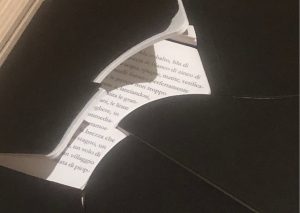
Mari’s response to this magnificent work involved taking the eighteen chapters which focus on Bartlebooth and turning them into eighteen miniature books (text translated into Italian) which all fit together to form a rectangular jigsaw puzzle of their own. Displayed inside a Plexiglass case, you get to peek at fragments of the story which are teasingly visible between their jet-black covers like pearls glimpsed inside oysters.
The piece which I adored the most, though, was Romanzo storico (Historical Novel), first published in 1975, which Mari wrote with author and poet Carla Vasio. It’s still in print, but a bit like the 16 Animali play puzzle set, there’d be no justification for the great expense of buying one, not unless a Lottery win comes my way.
The work appears to be simplicity itself. It’s a family tree, starting on the right with Angelo Fantin, an entirely made-up individual supposedly born in Milan in 1974. The document then traces Fantin’s ancestry back across more than 300 years and encompassing a total of 511 people — almost all of them working-class, which is Mari’s way of undermining the fact that family trees are usually only reserved for the nobility (or certainly were before the advent of amateur genealogy websites.)
We get the merest tantalising glimpses into the lives of the people on the branches of the tree from the jobs ascribed to them — ones you might expect, like cestaia (basket maker), maniscalco (blacksmith) and falegname (carpenter), as well as more unusual ones such as tessitore di arazzi (tapestry weaver), fonditore di campanacci (cowbell maker) and generale borbonico (General in the Bourbon army).
The exhibition catalogue says that “the project stemmed from Mari’s attempt to map his own lineage and its unwritten or forgotten histories”, and that it invites readers “to conjure the family’s stories for themselves.” Which indeed it did…
Back in 2019, I dipped my toes in this wonderfully niche world of creating homages to fake literary works with my own short story The Index (and once you’ve finished reading this, maybe you’d like to click over and read that?) — and having done it once before with J G Ballard, I think I’ve now settled on returning to this form again in 2025 with my own little (or probably not so little) homage to Signor Mari…

